
Ola Idris Ali
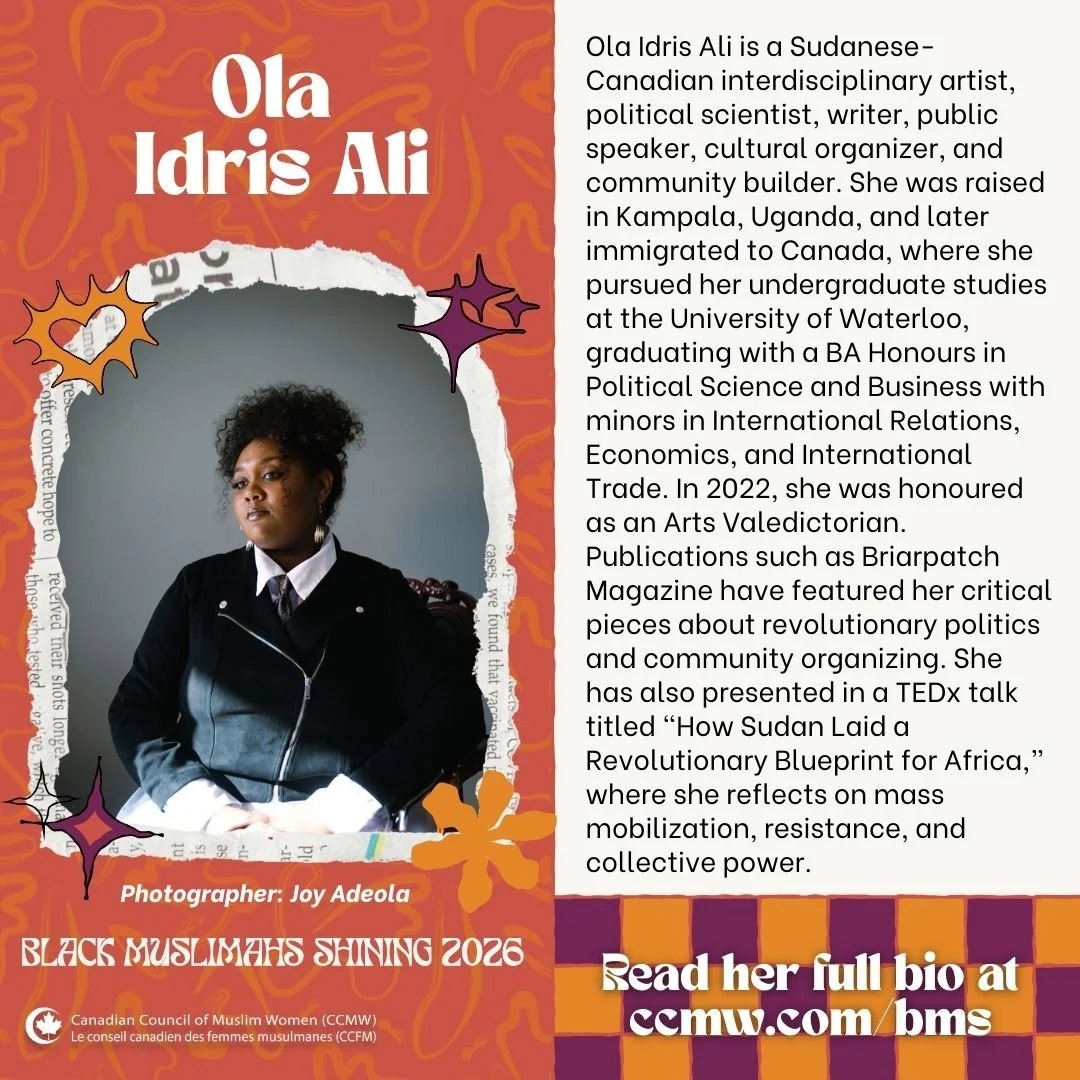
Ola Idris Ali is a Sudanese-Canadian interdisciplinary artist, political scientist, writer, public speaker, cultural organizer, and community builder. She was raised in Kampala, Uganda, and later immigrated to Canada, where she pursued her undergraduate studies at the University of Waterloo, graduating with a BA Honours in Political Science and Business with minors in International Relations, Economics, and International Trade. In 2022, she was honoured as an Arts Valedictorian. Publications such as Briarpatch Magazine have featured her critical pieces about revolutionary politics and community organizing. She has also presented in a TEDx talk titled “How Sudan Laid a Revolutionary Blueprint for Africa,” where she reflects on mass mobilization, resistance, and collective power.
At the core, she imagines herself as an evolving student of life, a friend, a fierce advocate for nature, and someone passionate about love reflected publicly as justice and cultural transformation and inwardly as a seeking of belonging and God.
What are the most meaningful aspects of this person's work and life?
Ola is a fellow member of Sudan Solidarity Collective. She is a diasporic Sudanese artist whose work sits at the intersection of politics, art and cultural practice. She is a creative curator and organizer who co-founded the art collective Fikra House, a space dedicated to collaborations rooted in liberation. Her life and work are rooted in rigorous political analysis and a deep commitment to building community across borders, identities, and disciplines. Her writing and speaking engagements teach others not only to understand resistance movements but also to engage with community networks, mutual aid, and solidarity, helping people move from individual worry to collective power.
How has this individual overcome the challenges they face?
Ola has dealt with so many different challenges in life. Ola has faced numerous challenges throughout her life, ranging from settling in Canada and navigating the realities of being a refugee to being a Sudanese diaspora person with strong ties to Sudan in a time of war and turmoil, among many others. She shows up with such vulnerability and openness, no matter how difficult life has been.
How has this individual empowered you and/or our communities?
Ola’s work amplifies voices often sidelined in media and academic spaces. By teaching that Sudanese and African liberation movements are not distant “causes” but models for solidarity and civic engagement, she strengthens global community ties. As the Programming Coordinator at the Regent Park Film Festival in Toronto, her work brings together beautiful films from often-overlooked artists and allows people to access these films for free.
Name a Black Muslim woman who has been an inspiration to you and why.
A Black Muslim Woman who has been an inspiration to me is Amina Wadud, a theologian who has been speaking specifically about the role of women in Islam and about understanding the Quran through a woman's lens. I also very much appreciate her, maybe controversial but necessary, affirmation of the rights of queer people within Islam, challenging the rigid understandings of gender binaries, and validating the significance of Islam in liberation movements and social justice globally.