
Asha Jama
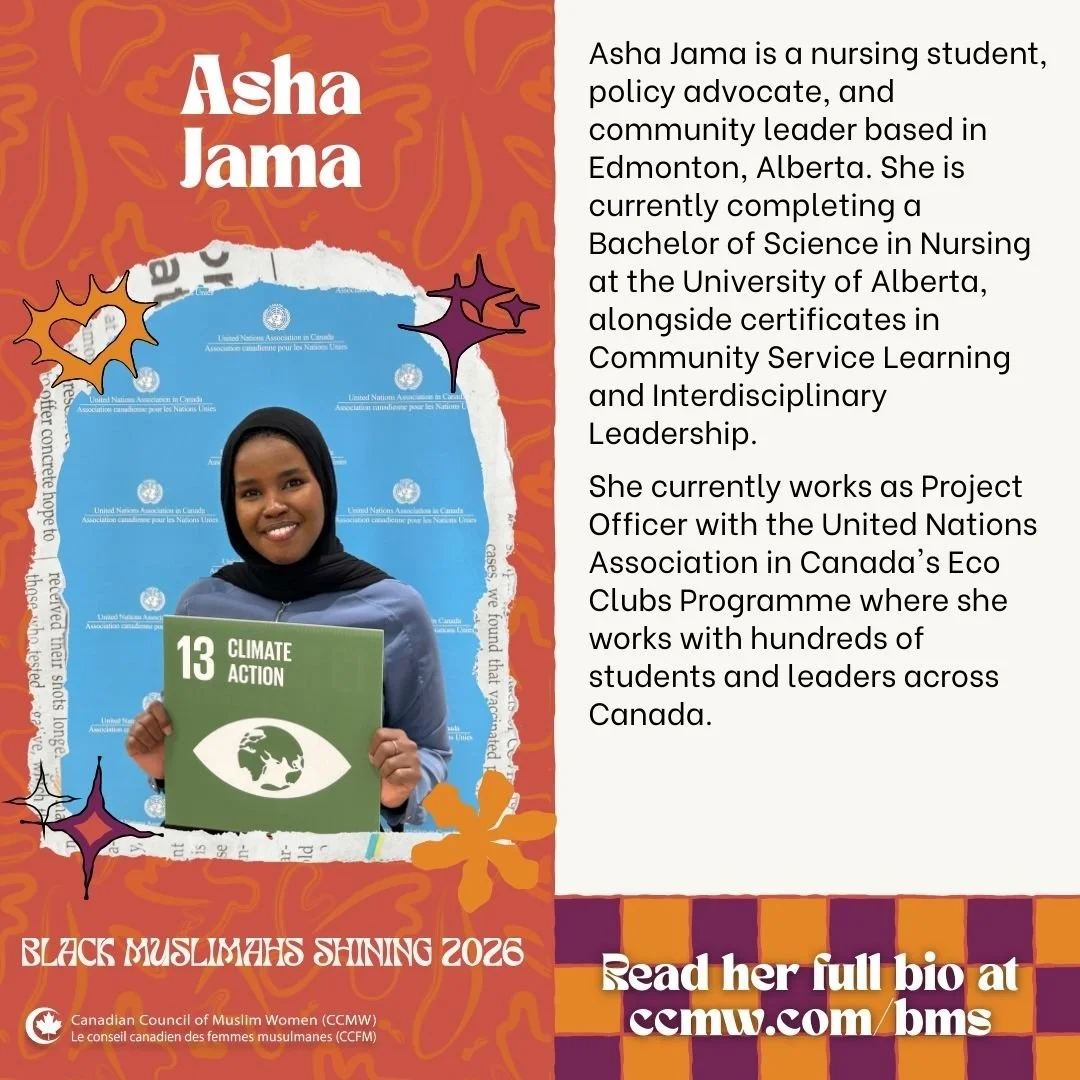
Asha Jama is a nursing student, policy advocate, and community leader based in Edmonton, Alberta. She is currently completing a Bachelor of Science in Nursing at the University of Alberta, alongside certificates in Community Service Learning and Interdisciplinary Leadership.
Recently, Asha’s focus has expanded to include sustainability and planetary health, with particular interest in how the Sustainable Development Goals (SDGs) intersect with health care systems and nursing practice. She currently works as Project Officer with the United Nations Association in Canada's Eco Clubs Programme where she works with hundreds of students and leaders across Canada.
Previously, Asha served as a constituency assistant in the Alberta Legislature and as a Voter Contact Organizer during the 2025 federal election, where she supported large-scale volunteer coordination and voter outreach efforts.
On campus, Asha has been elected for two consecutive terms as a Faculty of Nursing Councillor, representing the academic and professional interests of over 1,400 nursing students. She has also contributed to policy research projects on topics such as Black maternal health, including the opportunity to present advocacy priorities and policy recommendations directly to the Minister of Health in Ottawa. Her research experience also includes work on sexual and gender-based violence (SGBV), which she has shared on a global stage as a national Canadian delegate to the 69th United Nations Commission on the Status of Women at the United Nations in New York.
She is the co-founder of CAN Initiative, UBORA Women’s Initiatives; youth-led and community-funded organizations focused on leadership development, mental health, and equity for Black women and newcomer youth. Across her volunteer work, Asha has raised and secured over $50,000 in funding, supported thousands of students and community members, and consistently modeled intergenerational mentorship in practice. Her community leadership has been supported by multiple foundations and partners.
Asha hopes to continue working at the intersection of health, sustainability, and public policy, where she aims to combine clinical practice with advocacy to reform systems that disproportionately impact Black and Muslim women. She remains committed to advancing leadership and decision-making spaces that reflect the lived experiences of communities served.
What are the most meaningful aspects of this person's work and life?
The most meaningful aspects of Asha Jama’s life and work are her commitment to justice, service, and representation for communities that are often excluded from decision making spaces. Shaped by her experiences as a Somali Muslim woman and newcomer to Canada, she approaches leadership with a deep sense of responsibility rather than a pursuit of status or recognition. Whether through nursing, political advocacy, or community organizing, Asha consistently works at the intersection of care and policy, grounded in the belief that those most affected by systems must have a voice in shaping them.
Her work is deeply rooted in the Islamic principle of Ihsan, the pursuit of excellence and moral responsibility in service to others. She is motivated by the struggles and sacrifices of past generations, including the women’s rights and civil rights movements, that made it possible for people like herself to exist and lead in today’s world. Carrying this legacy forward, Asha is driven by a commitment to honor that work through action, guided by the belief articulated by Muhammad Ali: “When a man says ‘I cannot,’ he has made a suggestion to himself. He has weakened his power of accomplishing that which otherwise would have been accomplished.” For Asha, meaningful change requires courage, persistence, faith, and an unwavering refusal to accept imposed limitations.
How has this individual overcome the challenges they face?
At a very young age, in the midst of war, Asha witnessed her father bleeding profusely after being shot by terrorists. This moment marked a profound turning point in her life. From that day forward, she was driven by a desire to save lives and support those harmed by violence, conflict, or tragedy. She wanted to be present for the injured, whether in war zones or everyday emergencies, and decided early on that she would become a doctor.
When Asha and her family relocated to Canada, the move represented safety and opportunity, including access to education for both boys and girls and the hope of building a stable future. However, she was unprepared for the reality of being racialized for the first time. In a society where she had always been surrounded by people who looked like her, Asha suddenly became “the other.” As a visibly Muslim Hijabi woman, the looks she received on public transit made her feel out of place and hyper visible in ways she had never experienced before.
Asha arrived in Canada during a period of heightened Islamophobia. Before leaving for school each day, her father would warn her, “Be careful, watch your surroundings.” Local Edmonton news frequently reported attacks against Black Muslim women, and fear became a daily reality for many in her community. Back home, Asha’s fears had centered on war interrupting her education or being displaced in search of safety. She had believed those struggles were behind her.
Yet one lesson Asha learned early in life was resilience, a quality deeply emphasized in Islam. As the Qur’an reminds us, “Indeed, with hardship comes ease.” Guided by this belief, Asha made a conscious decision not to retreat into fear. She resolved to confront the narratives imposed on her identity and to change how the world perceived her. With courage, she promised herself that she would not shrink in the spaces she entered, but instead transform them.
The challenges extended beyond identity. Asha’s family came from a lower socioeconomic background, and as an immigrant, she navigated systems without the advantage of generational knowledge, networks, or institutional familiarity. No one in her family had graduated high school, let alone university. She found herself competing with peers whose families had lived in Canada for generations, who possessed cultural fluency and social capital she had to build from scratch. Still, she remained undeterred. Every obstacle became, in her eyes, a sign from God that another door would open. The African proverb, “If one door closes, another opens,” fueled her determination to wake early, sleep late, and take the bus to school and work through harsh Alberta winters.
Through these experiences, Asha became increasingly aware of how systemic barriers prevent marginalized communities from having a voice in leadership and decision making spaces. She saw policies crafted about communities, without their participation. Witnessing legislation such as Quebec’s Bill 21, which restricts women’s freedom of expression and choice, further solidified her understanding of how exclusion operates at the policy level. This realization compelled her to pursue politics and advocacy, determined to ensure that people like herself would no longer be absent from the rooms where decisions are made.
How has this individual empowered you and/or our communities?
Through her work in politics, advocacy, and community leadership, Asha has empowered Black Muslim women, newcomer youth, and marginalized communities by ensuring they are represented in spaces where decisions are made. Entering politics early, she worked and campaigned for Alberta’s first Black Muslim Member of the Legislative Assembly, Sharif Haji, who was successfully elected. In this role, Asha coordinated legislative affairs and supported a constituency of over 50,000 residents, gaining firsthand experience in how policy directly shapes people’s lives.
Asha has also played a significant role in electoral organizing at the federal level. During the most recent federal election, she served as a volunteer coordinator for the NDP, managing hundreds of volunteers, supporting large scale Get Out the Vote efforts that reached thousands of voters, and helping to raise tens of thousands of dollars. Through this work, she helped strengthen civic participation while demonstrating that young Black Muslim women belong at the center of political organizing and leadership.
Beyond partisan politics, Asha has advocated nationally for Black maternal health, a critical yet often overlooked issue. She met with Members of Parliament and senators, including the current Minister of Health, Marjorie Michel, to present evidence based research highlighting that Black women are three times more likely to die during childbirth than their counterparts. By bringing this data directly to federal decision makers, Asha helped elevate Black women’s lived experiences into national policy conversations.
Within academic spaces, Asha has empowered her peers through student governance, representing over 1,400 nursing students through her university’s student union. She has been elected to this role for two consecutive terms, using her platform to advocate for equitable policies, student wellbeing, and inclusive leadership. Despite being a student, she has balanced rigorous clinical training with research and community work, including collaboration with professors and clinicians at the Sexual Assault Centre, where she gained expertise in sexual and reproductive health.
Driven by her commitment to justice and equity, Asha has co founded multiple community initiatives. She founded Creating Accessibility for Newcomers, an initiative that served hundreds of youth by securing over $10,000 in funding to support winter sports programming aimed at improving mental health and addressing seasonal depression. She also co founded UBORA Women’s Initiative, a federally incorporated, youth led organization supporting Black women in accessing leadership spaces, decision making roles, and global opportunities. This work was inspired by her selection as a national delegate for Canada at the 69th United Nations Commission on the Status of Women in New York, where she was chosen among hundreds of applicants.
Throughout her political and advocacy journey, Asha has often been the only young Black Hijabi woman in the room, including spaces with hundreds of party members. Rather than allowing this isolation to discourage her, she has used it as motivation to open doors for others. Today, Asha mentors over three hundred youth across Canada, equipping them with skills in advocacy, leadership, and project development through her work with the United Nations Association in Canada. Her efforts have reached tens of thousands of people, secured over $50,000 in funding, been featured by CBC, and contributed to national and global conversations on gender justice, mental health, maternal health, planetary health, and equity.
Despite these accomplishments, Asha remains grounded in the understanding that she often had to begin from far behind. She has worked tirelessly to access opportunities that were readily available to others, and she continues this work with the intention of building a future where Black Muslim women and marginalized communities no longer have to fight for visibility, but are recognized as leaders shaping the world around them.
Name a Black Muslim woman who has been an inspiration to you and why
A Black Muslim woman that inspires me is Ms. Amina J. Mohammed - the Deputy Secretary-General of the United Nations and Chair of the United Nations Sustainable Development Group. I aspire to be in similar leadership roles with the United Nations Insha Allah.